Kategorie: Unterrichtsmaterial
Worksheet 1: Human rights and civil rights in US cinema: Introduction
Worksheet on human rights and civil rights in US cinema – for high school students

Human rights and civil rights in US cinema: Introduction to the subject
Before the screenings:
a) Read the following excerpt from the US Declaration of Independence:
“We hold these truths to be self-evident, that all men are created equal, that they are endowed by their Creator with certain unalienable Rights, that among these are Life, Liberty and the pursuit of Happiness. — That to secure these rights, Governments are instituted among Men, deriving their just powers from the consent of the governed [...].”
Then explain the following terms in your own words:
“all men are created equal”
“unalienable rights”
“consent of the governed”
b) Discuss the following questions in class:
What are the rights to which all people are entitled?
What values are at the heart of the declaration?
In what way could these statements remain relevant today?
c) Split up into pairs. Together, read the dossier article Zum Inhalt: Zwischen Selbstvergewisserung und Hinterfragung (’Between Self-Affirmation and Self-Critique’).
Highlight passages that contain statements on:
the importance of the Declaration of Independence,
the development of civil and human rights in the US,
the role of Hollywood cinema,
groups who were denied the promised rights for a long time,
optional: criticism and myth-building in US cinema.
d) Discuss the following questions in class:
What are the main messages regarding the development of civil rights in the United States?
Over the course of film history, which social groups have increasingly come into focus? What role can cinema play when it comes to the visibility of marginalized groups?
The results of your discussions will form the basis for the subsequent film screening and presentations.
During the screenings:
e) Split up into six small groups. The following six movies will be divided up between them:
"The Man Who Shot Liberty Valance" (John Ford, USA 1962)
"Smoke Signals" (Chris Eyre, USA 1998)
- Zum Filmarchiv: "Milk"
(Gus van Sant, USA 2008)
- Zum Filmarchiv: "Selma"
(Ava DuVernay, USA 2014)
"Do The Right Thing" (Spike Lee, USA 1989)
"Minari" (Lee Isaac Chung, USA 2020)
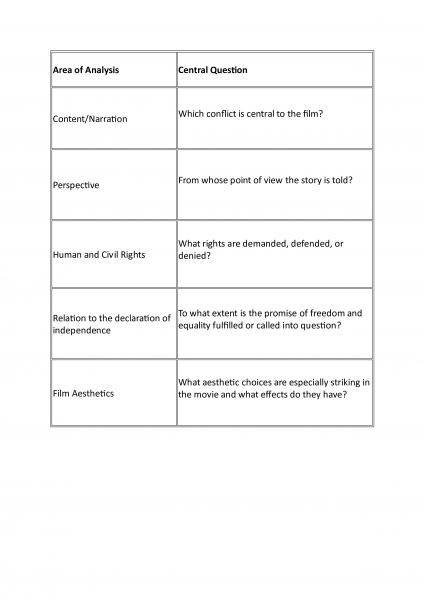
While watching the film, take notes on the following areas of analysis:
After the Screenings:
f) Remain in small groups and complete your notes. Pick out scenes that back up your observations and analyses.
Prepare a presentation of approximately 10–15 minutes, including at least one of the Zum Inhalt: scenes you selected.
The presentation should include the following:
A brief introduction to the content,
the most important results of your analyses,
a conclusion in one or two sentences:
“The film demonstrates that...”
g) Make your presentations in class.
The audience should take notes of the key findings based on the analysis grid from exercise e).
Check whether the presenting group has applied the analysis grid sensibly to the film they watched.
During the presentations, note your observations in the following grid:
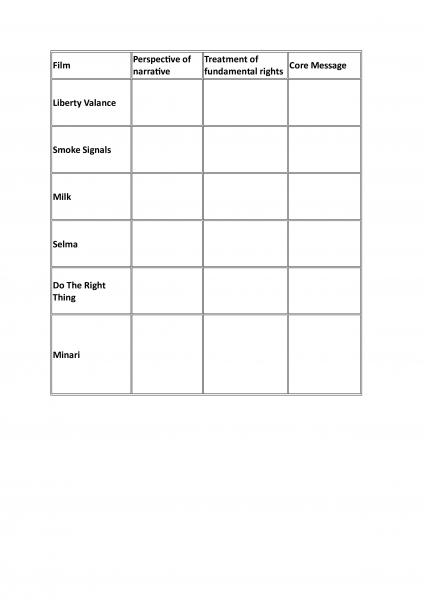
h) Complete and refine the grid. Compare notes from presentations and, where applicable, fill in any missing information.
Discuss the following questions:
What do the films have in common and what makes them different from each other? Have you noticed any continuities?
Which films tend toward idealism, and which tend toward critique?
Which social groups are at the center of the respective films?
Together, create a shared final product (e.g. a poster, digital noticeboard, analytical chart, etc.). Make sure you highlight central connections and developments.
i) Closing Discussion: Discuss the following questions in class:
Which groups increasingly gained a voice throughout the history of US cinema?
Which promises in the Declaration of Independence are fulfilled?
Which remain controversial or unfulfilled?
How does the view on US society change from one film to another?